How to destroy PFAS adsorbed on activated carbon? DESOTEC’s innovative thermal treatment
Capturing PFAS is only the first step. At DESOTEC, we go beyond PFAS removal by ensuring their complete destruction through a thoroughly validated thermal process. In this article, we explain how PFAS captured on activated carbon are fully desorbed and mineralised, as well as the multiple analysis and validation steps implemented to ensure the complete elimination of these persistent pollutants. This validated process prevents secondary pollution and offers a truly sustainable solution for PFAS treatment.
The need for a sustainable solution for PFAS treatment and destruction
In recent years, global awareness of the severe environmental and health risks posed by per- and polyfluoroalkyl substances (PFAS) has grown, prompting more stringent legislation.
Activated carbon is one of the best available techniques (BAT) for the removal of PFAS. At DESOTEC, we have built strong expertise for safe PFAS removal, even developing a hybrid activated carbon grade to optimise the capture of both short and long chain PFAS molecules.
But removing PFAS from contaminated water or soil is only half the work. Eliminating PFAS – fully mineralising these hazardous molecules – is crucial to protect the environment from secondary pollution.
Driven by this goal, DESOTEC has developed a thorough process to treat PFAS-contaminated activated carbon waste. This process was validated after a series of verification steps, including a review of independent literature, the development of a reliable method to measure PFAS level on spent carbon, and investigations into the PFAS destruction and mineralisation efficiency of our reactivation process and flue gas treatment.
Our analysis proves that our process does not merely shift PFAS away from customers’ sites but eliminates it for good.
This article explains this process and the multiple verification steps that guarantee the full destruction of PFAS molecules.
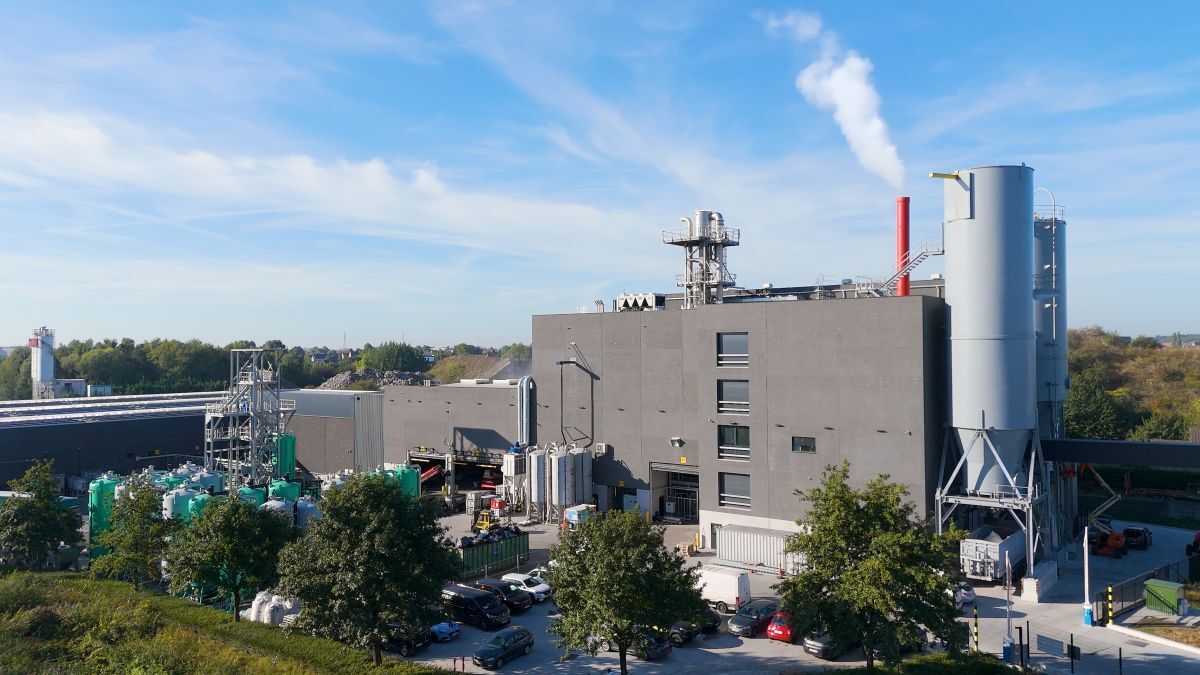

DESOTEC’s innovative process for PFAS destruction
Our treatment of spent granular activated carbon (GAC) involves:
1. Thermal treatment: pyrolysis in multi-hearth or rotary kilns to desorb all contaminants, including PFAS, and reactivate or recycle carbon for reuse:
- Total residence time: approximately 105 minutes or 15 minutes/hearth.
- Maximum temperatures: ~850°C for 30 minutes (2 hearths) during reactivation and 950-1050°C for 3-4 sec in the post combustion chamber (PCC), measured at the outlet of the PCC.
2. Flue gas treatment: this step is to fully destroy contaminants which were desorbed (and partially destroyed) in the pyrolysis step. Desorbed PFAS are decomposed and fully eliminated in this process. Off-gases go through an evaporative cooler, dry scrubber with activated carbon and sodium bicarbonate injection, a baghouse filter, a wet scrubber with circular stream, and an activated carbon filter, before the purified gases exit the stack.
What steps did DESOTEC’s R&D take to develop this innovative PFAS destruction process?
1- Literature review of PFAS-loaded activated carbon treatment
Independent studies find that at typical reactivation temperatures – roughly 300-900°C – PFAS compounds start to significantly decompose and defluorinate.
A further important insight is that when PFAS are adsorbed onto the carbon surface, their degradation improves. This is attributed to surface-mediated or catalytic effects, where the carbon facilitates the breaking of the very strong C–F bonds (read the study here).
The process in the furnace take place in two clear steps:
1. At lower and intermediate temperatures, PFAS molecules first break down into larger and then smaller volatile fluorinated intermediates. These intermediates can temporarily desorb and re-adsorb on the carbon, further enhancing their breakdown (read the study here).
2. The afterburner, operating at 950-1050°C with a residence time of more than two seconds, ensures optimal reaction conditions to completely destroy the remaining intermediates. Destruction efficiencies are above 99% for key compounds like trifluoromethane (CHF₃), and 80-99% for more stable species such as hexafluoroethane (C₂F₆) (read the study here).
This literature review gave us a solid basis to proceed with full-scale tests.
2- Measuring PFAS level on activated carbon waste: DESOTEC and VITO’s new method
Our first step was mapping the extent of contamination on the waste arriving at our facilities – essential to comply with the EU’s POP Regulation. This stipulates that carbon may be thermally reactivated only if the PFAS concentration is below the limit of: 1mg/kg PFOA; 1mg/kg PFHxS; 50mg/kg PFOS. If the PFAS level exceeds the POPs threshold, the carbon must be disposed of at a specialised facility, e.g. through incineration.
At the time, there was no reliable analysis method for PFAS adsorbed onto activated carbon, so DESOTEC developed its own in collaboration with the independent Belgian Research Institute VITO.
This has been validated by the Flemish government’s Institution for Technology and Research and is now an official method for Flanders.
3- Thermal treatment of PFAS-loaded spent carbon: PFAS analyses on reactivated carbon demonstrate PFAS destruction
We analysed eight spent carbon samples, and found they contained at least five PFAS compounds at concentrations ranging from 30-8 500 µg/kg.
After reactivation, none of the 20 PFAS compounds covered by the EU Drinking Water Directive was detectable. Taking a worst-case scenario approach, where every non-detection was treated as being at the detection limit, we calculated a minimum removal efficiency of between 98.34% and 99.99%.
Further testing for two additional PFAS compounds showed removal rates of more than 99.99%. In total, almost 50 mg/kg of PFAS was removed by our thermal treatment process.
We also measured total and organic fluorine using CIC analysis. The spent carbon contained much more organic and inorganic fluorine than could be explained by the PFAS compounds only. After reactivation, no organic fluorine was detected, and some harmless inorganic fluorine was found on the carbon, indicating mineralisation.
Overall, 83% of the total fluorine was removed during pyrolysis, confirming that the process was effective at breaking down PFAS and other fluorinated compounds.
4- Flue gas treatment: destruction of PFAS molecules and mineralisation into harmless inorganic fluorine
The flue gas treatment system, including the scrubber and baghouse filter, plays a crucial role in the elimination of PFAS mineralisation products.
In our tests, only trace amounts of PFAS were detected in the waste salts, which may have come from the used scrubber water or from the installation’s coatings and seals.
Fluorine concentrations in the flue gas salts were significantly elevated, indicating that organic fluorine compounds were mineralised into harmless inorganic fluorine compounds. Similarly, salts from the evaporative cooler showed elevated fluorine levels, though PFAS were mostly undetectable. These salts are then safely disposed of via specialised companies.
Scrubber water samples showed no PFAS above detection limits, making it compliant. Inorganic fluorine levels in scrubber water increased over time, supporting the hypothesis that PFAS mineralises into hydrogen fluoride (HF), which is neutralised by sodium hydroxide (NaOH) and sodium bicarbonate (NaHCO3) to form sodium fluoride (NaF). Over time, these compounds are evacuated via the bag house filter since the scrubber water is used in the evaporated cooler.
The total fluorine found in the scrubber water was greater than the amount of PFAS put into the system, further confirming that PFAS were extensively broken down and converted to inorganic fluorine.
5- Chimney emissions analysis, an essential check for environmental compliance
We carried out an important final check: on stack emissions via OTM-45 (*). We tested these for three hours during the reactivation process and had our findings independently checked.
Our analysis looked at more than 40 PFAS compounds across samples collected in six parts of the sampling system, including a filter, condenser, water bubbling flakes, and XAD resins. No traces of PFAS were found.
Importantly, none of the seven PFAS compounds found on the saturated carbon and listed in the Drinking Water Directive were detected in the chimney emissions. This indicates that the thermal reactivation process and flue gas treatment successfully destroyed PFAS before the gases were released into the atmosphere.
These findings support our hypothesis that this innovative process for the treatment of PFAS-loaded carbon prevents PFAS release into the environment – even for carbon with high PFAS loads.
(*) Other Test Method 45 - (OTM-45) Measurement of Selected Per- and Polyfluorinated Alkyl Substances from Stationary Sources. (Read more here)
6- Measuring the PFAS Destruction and Removal Efficiency (DRE)
We calculated the destruction and removal efficiency (DRE) in two ways.
The first looked at the amount of PFAS in the spent carbon, the reactivated carbon and the chimney emissions; the second examined only the exhaust emissions. We took the cautious approach of assuming that PFAS could have been present in the stack emissions at the lowest level that the tests could detect (even though none was actually detected).
These tests showed that on average, the DRE was greater than 99.97% for the sum of target PFAS, indicating that the reactivation process and flue gas treatment system achieved complete destruction and removal of PFAS.
How to guarantee that PFAS are fully destroyed in this process? DESOTEC extra verification step
Calculating the Fluorine Mass Balance
To double-check that the PFAS had been destroyed, we carried out a fluorine mass balance check across key input and output streams, including saturated carbon, reactivated carbon, flue gas salts and scrubber water. This measurement is the only accurate way to measure any PFAS or fluorinated compound, even partially destroyed.
We found that approximately 96% of the fluorine fed into the furnace could be accounted for in the outputs. This very high recovery rate strongly confirms that PFAS compounds were mineralised into inorganic fluorine, primarily hydrogen fluoride (HF), then neutralised into sodium fluoride (NaF) through scrubbing.
One key discovery was that the total fluorine recovered in the flue gas salts and scrubber water exceeded the amount of targeted PFAS that had been fed into the system. This is likely due to non-target PFAS, other organofluorines, or inorganic fluorine, on the spent carbon.
This confirms that the reactivation process not only destroys PFAS, but also converts a significant amount of fluorinated content into stable inorganic forms, ensuring environmental safety and compliance with POP regulations.
For extra verification, we measured for tetrafluoromethane (CF4) – last compound before full mineralisation – and products of incomplete combustion (via OTM-50), which would be present if the combustion was incomplete. We found none, proving that the PFAS had been completely mineralised.
These findings were confirmed during multiple measurement campaigns and validated by third parties.
Key findings & conclusion
DESOTEC’s R&D team is continuously gathering data and executing PFAS measurement campaigns to guarantee complete PFAS destruction and safeguard our environment and health. Our tests show that:
1. Activated carbon is more than a removal technology: It does not only capture PFAS, but, combined with a thorough thermal treatment, plays an active role in their degradation. The combination of adsorption and catalytic surface effects already initiates breakdown before final destruction.
2. Industrial thermal treatment of PFAS loaded carbon enables near-total PFAS destruction: Our full-scale data shows destruction efficiency consistently above 99.97%, often exceeding 99.99%, even using a conservative assessment approach. This is achieved through the combination of high temperature, sufficient residence time, and optimised flue gas treatment.
3. PFAS are effectively mineralised, not transferred: The fluorine mass balance demonstrates that PFAS are converted into stable inorganic fluorine. No PFAS emissions are detected at the stack, confirming their complete elimination.
Therefore, we can confirm that the DESOTEC thermal process and flue gas treatment of PFAS-loaded activated carbon is a safe, proven, and scalable solution for PFAS destruction.
-
Industrial PFAS removal
Finding PFAS in the environment is a huge concern globally. For industry, it’s a challenge that companies must now tackle head-on. DESOTEC provides reliable, flexible solutions to eliminate PFAS pollution permanently and sustainably. -

Our filtration solutions
We offer a wide range of filter models and carbon grades to suit your industrial water or air purification requirements. -

Our unique service
Our closed-loop, full-service model is as unique as your business needs. We’ll define the right filtration setup and safely recycle filtration waste, making it easy to go green.