How Businesses can Reuse Industrial Water to Mitigate Drought Risk
The increasing threat of drought is driving businesses across Europe and the rest of the world to reduce pressure on freshwater supplies by treating and reusing industrial water. By adding DESOTEC’s sustainable mobile activated carbon filtration solutions to existing wastewater treatment plants (WWTPs), companies are obtaining a source of water that can be reused in industrial processes.
Why Reusing Water Makes Business Sense
In summer 2022, Europe experienced what is believed to be its worst drought in at least 500 years, with two-thirds of territory (EU+UK) under drought warnings or alerts.
High temperatures and low precipitation & snowpack have persisted in many regions across the world. Even in the winter and spring months of 2023/2024, drought was affecting areas including Spain and Sicily in Europe..
In February 2024, Spain declared a state of emergency and imposed water restrictions in Catalonia after reservoir water levels dropped to below 16% of capacity. It began shipping drinking water from Valencia and Marseille, and announced a €467m investment in two desalination plants near Barcelona to treat 80m³ of water annually.
Summer 2026 has been a worrying confirmation of climate-driven drought, forcing authorities to impose water restrictions across 70% of the French territory. To a lesser extent, other countries in Europe have been affected, including the UK, Switzerland and Germany.
Less rain and very hot temperatures mean a low water level in major rivers. This cascades into a bunch of issues. For instance, not being able to draw enough cooling water from the Danube forced the shutdown of a nuclear power plant in Hungary and a hydropower facility in Serbia.
As climate change worsens, it is forecasted that global freshwater demand will outstrip supply by 40% by 2030. Therefore, the pressure is on to water down freshwater usage.

The Thirst of Rethinking Industrial Water Use
Industry is a major global water stressor, drinking up huge volumes in processes such as cleaning, cooling and rinsing.
In 2020, industry was responsible for 45% of freshwater withdrawals in the EU, against a global average of 15%. The figure rose to 81% in Belgium and 92% in Estonia.
Usually, wastewater is treated prior to being discharged. However, investing in water reuse is becoming critical for many sectors for several reasons.
Most pressingly, it allows plants to continue operations during times of drought and restrictions, when drinking water supplies become prioritised for human consumption and pumping in nearby rivers is restricted. This ensures firms keep operating safely and at their usual standards of cleanliness, avoiding costly production downtime.
It also boosts circularity and sustainability, reducing the pressure on the local environment. This in turn improves a company’s reputation among neighbours and customers.
Furthermore, as legislation around industrial water usage may well be tightened in the coming years, a robust water reuse system is becoming an important future-proofing measure for many businesses.
Water Sources That Industries Can Tap Into
Industries may be able to reuse water from sources including:
- WWTP effluent;
- Processes;
- Condensation;
- Cleaning and rinsing;
- Cooling;
- Groundwater.
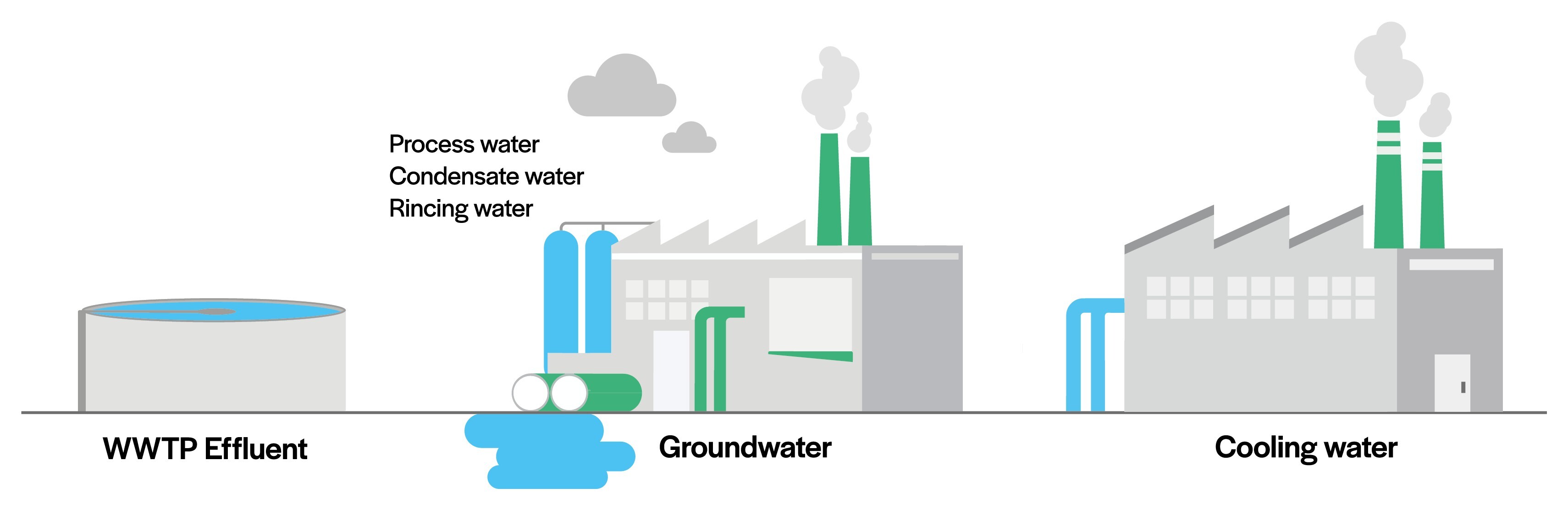
However, before being suitable for reuse, wastewater must be treated. In particular, here is a breakdown of the contaminants to remove for each type of polluted stream:
- Process water: PFAS, COD, BTEX, PAH, AOX.
- Rinsing water: COD, detergents, soaps.
- Cooling water: COD, residual oils.
- Condensation water: Residual solvents.
- WWTP effluent: PFAS, COD, micropollutants.
- Groundwater: PFAS, COD, BTEX, PAH, AOX.
Typically, the end-use of treated water is the same as its original source, e.g. process water is reused in industrial processes, and water from cooling reactors is recycled for the same purpose.
An appropriate purification treatment enables water to have the required quality grade and avoid contaminating processes, equipment or products with hydrocarbons, bacteria, etc.
Once treated, water can be reused in a wide range of applications, such as washing and cooling reactors and other equipment. In addition to this, farms could recycle purified water for irrigation.
DESOTEC’s Sustainable Mobile Filtration Solutions for Water Reuse
To purify wastewater of the above-mentioned pollutants, companies can harness DESOTEC’s activated carbon-based sustainable mobile filtration solutions.
Our technologies are mostly used as a polishing step after existing WWTPs. Sometimes, sand filters are placed before our units to remove suspended solids.
DESOTEC mobile filters offer several advantages to customers:
- They are supplied on a rental basis, with no need for upfront investment. This makes them ideal for temporary needs such as periods of drought, although many companies keep them in situ for longer.
- They are mobile, so can be supplied within days from one of our hubs. They also start filtration immediately, thus being suitable for emergency situations.
- Our system is modular and adaptable to changing circumstances or unforeseen requirements. Filters may be simply added in parallel or series to handle increased flow rates or components.
- DESOTEC filters are easy to install and require minimal floorspace, so sites do not need to undergo major or costly changes to their facilities.
- They are simple to exchange in a process that takes just 30 minutes, minimising production downtime.
- Filtration waste is sustainably handled by DESOTEC away from customers’ sites. We transport closed filters to our state-of-the-art facilities, where the saturated carbon is analysed and sorted. Components that were adsorbed onto the carbon are desorbed and destroyed in our furnaces (including PFAS, as per the POP regulation), or valorised for reuse. Wherever possible, the carbon is then reactivated for reuse, driving down customers’ costs and improving sustainability.
Case studies
DESOTEC partners with clients in several sectors on water reuse projects. In all cases, the water is tested after treatment and found to meet the required purity standards for reuse.
1. Plastic industry
A Polish company recycles plastic granules and pellets, producing wastewater from washing, rinsing and cooling processes. The wastewater contains traces of food and cleaning products, with impurities including BTEX, PAH and mineral oils, measured as COD.
The company is keen to boost sustainability by reducing its usage of freshwater.
DESOTEC supplied a MOBICON 2000 filter to treat a flow of 5-15 m³/h, removing the organic impurities. It is preceded by other technology such as a WWTP, including dissolved air flotation (DAF), and a sand filter to remove suspended solids.
After treatment and testing, the water is reused to rinse granules, closing the loop and helping the company achieve its green goals.
2. Metal industry
A metal company abstracts and treats canal water for use in its processes. During the summer, the canal water levels drop and the concentration of impurities rises, meaning the site’s WWTP is no longer adequate.
DESOTEC has placed a MOBICON filter downstream of the WWTP to provide an extra layer of treatment, removing the residual COD.
Treating a flow rate of 60m³/h, the system enables the continuous production of process water without investment in major plant upgrades. It is also helping to protect the local environment by reducing stress on water courses.
3. Cellulose/ paper industry
A Spanish paper pulp manufacturer uses water from a nearby river in its processes. During the severe drought of 2023, it was unable to obtain water and had to stop production.
The company therefore decided to add an extra treatment step to its WWTP so it could reuse its process water rather than simply discharging it.
DESOTEC placed three MOBICON filters in parallel, containing our ORGANOSORB 10 carbon grade. These remained in place for four months, enabling the manufacturer to resume production throughout the drought.
4. Food industry
A food company needs water to wash chickens on food safety grounds. Due to the high flow rates, it taps into groundwater. However, the company detected the groundwater had become contaminated with pesticides and faced the choice of stopping production, using drinking water, or finding a new purification solution.
DESOTEC supplied a MOBICON filter to treat the flow rate of 50m³/h so the water was safe for rinsing foodstuffs.
5. PFAS
A company asked DESOTEC to assess the reuse of wastewater as process water, with the main objectives of reducing the COD level (from 100 to 25 mg/L) and keeping PFAS concentrations under control. A pilot test was initially conducted using the MOBICON 2000 filter to evaluate the treatment performance of the contaminated flow (5 m³/h). Results from the trial confirmed the filter to be suitable for the initial purpose.
-

Our filtration solutions
We offer a wide range of filter models and carbon grades to suit your industrial water or air purification requirements. -

Waste and wastewater management
Sustainable air and water purification for waste management and recycling to protect our environment and control odours. -
COD & BOD treatment
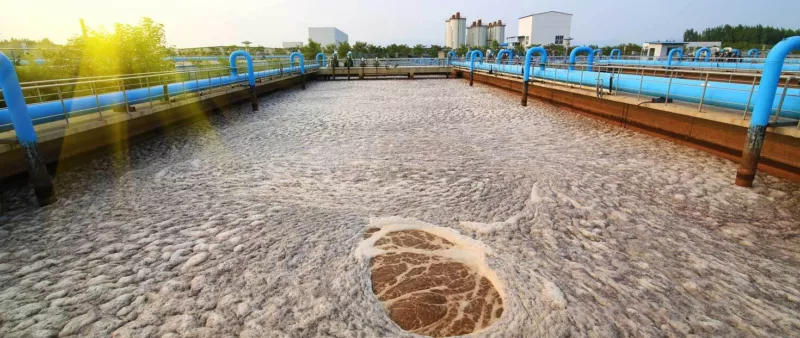
By complying with chemical oxygen demand (COD) and biochemical oxygen demand (BOD) limits before discharge to the environment or the sewer, companies ensure that waterways and WWTP biofilters remain healthy. Check DESOTEC filtration solutions.