Pesticides
About
Whether it’s remediating groundwater at farms, purifying rinsing waters from food processing, or treating wastewater from pesticide manufacturing, DESOTEC has a simple and sustainable answer. Our mobile filtration solutions decontaminates wastewater from adsorbable organic halides (AOX), chemical oxygen demand (COD), and biological oxygen demand (BOD), allowing for its safe discharge or reuse.
Why treat pesticides in wastewater?
About 450 pesticides are approved for use in the EU. They contain organic molecules from several chemical families, e.g., glyphosate from phosphonic acid and atrazine from triazine.
Many of these molecules are known to require treatment on environmental grounds. Their chemistry ranges from being very acidic to alkaline. You have AOX including chlorinated, fluorinated, or toxic compounds that must be removed to protect aquatic life and the human food chain. Together, these compounds may be measured as COD or BOD. Their removal is essential to keep waterways aerated and healthy.
DESOTEC’s mobile activated carbon filtration solutions provide simple and sustainable answers to all these issues, ensuring that water is safe for discharge or reuse.


Surface water and groundwater remediation for pesticides
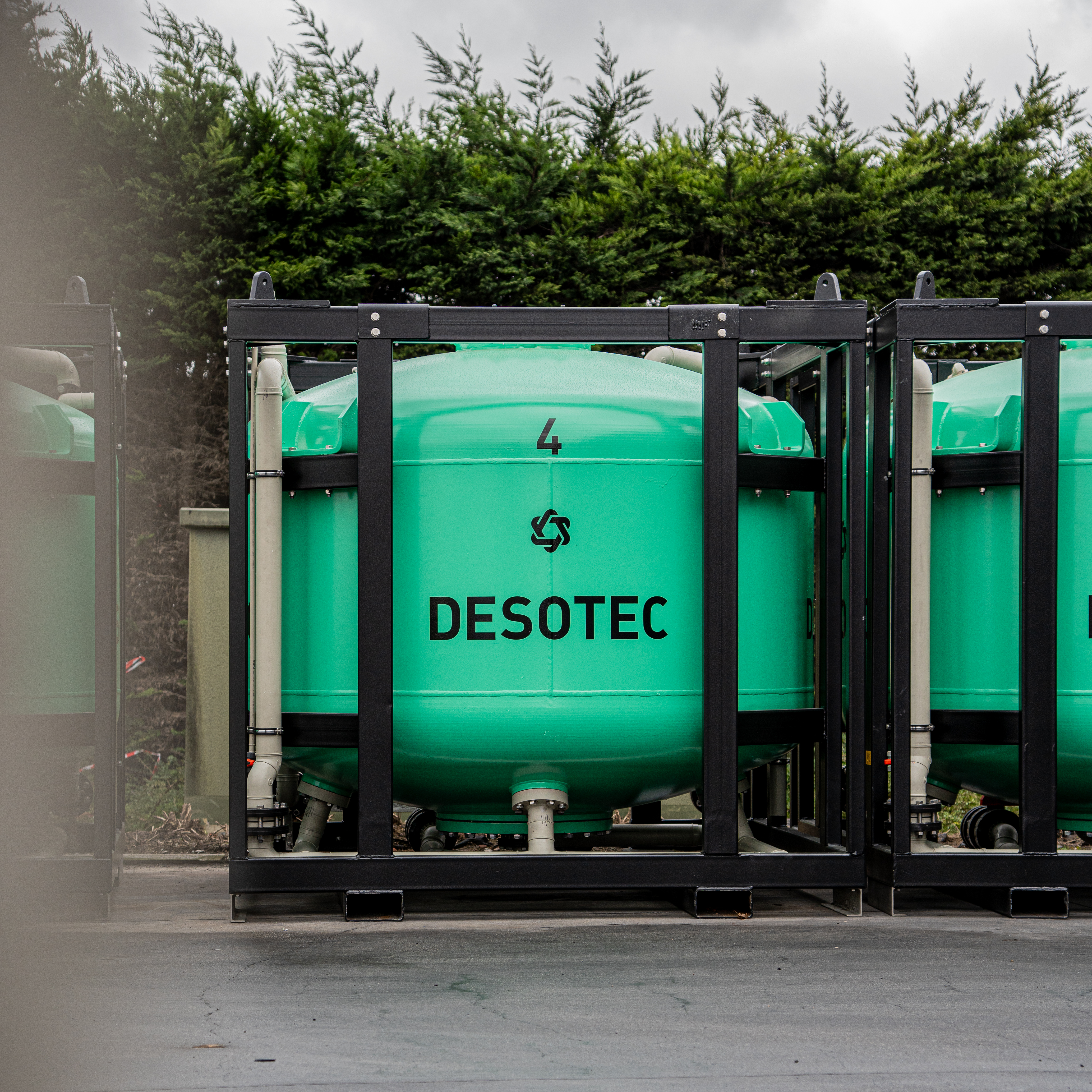
DESOTEC’s mobile filters are easy to use on farms. Their small footprint makes them ideal for busy agricultural sites, while their simple technology means they do not require operators in situ.
Pesticides are found in waters resulting from rinsing tools and machinery. This wastewater may be pooled and passed over the filters. Unlike many alternative technologies, activated carbon is suitable for batch treatments. Once treated by activated carbon, the water is safe for industrial reuse (e.g., washing or cooling equipment). Alternatively, it can also be discharged to the environment or sent to wastewater treatment plants (WWTPs) for further purification .
Where pesticides have entered the groundwater through rainfall run-off or by seeping into the soil, remediation is required. Groundwater is pumped up and passed through the filters before being returned to the land. As DESOTEC filters are mobile, they are well suited to both long-term and temporary applications, e.g., where spills have occurred.
Industrial wastewater treatment for pesticides
Rinsing waters from manufacturing may contain high concentrations of pesticides. In food processing, wastewater from rinsing fruit and vegetables may also contain traces of pesticides. Failing to reduce the pesticides load before sending wastewater to WWTPs would kill off the bacteria used in biofilters. DESOTEC filters provide effective pre-treatment, allowing for safe discharge of the wastewater to the sewer. It may also be possible to reuse it, boosting sustainability and driving down customers’ costs.
Pesticides are essential for plant and animal health, thus securing our food supply. DESOTEC’s mobile activated carbon filters are ideal for wastewater treatment. They can purify rinsing water and groundwater in the agricultural sector, protecting your business, our environment, and the human food chain.
Helping you comply
The EU Water Framework Directive sets quality standards for surface and groundwater. These are regulated through national and regional legislation as well as COD, BOD, and AOX limits.
Municipal WWTPs also set acceptance limits for COD and AOX concentrations in wastewater.
In general, laws and WWTP limits are becoming ever stricter. By installing DESOTEC’s modular filtration solutions, you can future-proof your agricultural business today.
Frequently Asked Questions about Pesticides and Fungicides traces removal
-
Pesticides and fungicides may contain a huge range of molecules, measured together as chemical oxygen demand (COD), that may harm the environment, starve waterways of oxygen, and enter the human food chain. Certain compounds often found in pesticides and fungicides, including adsorbable organic halides (AOX), are subject to additional restrictions due to their toxicity. Furthermore, some fungicides may decompose into 1,2,4-triazole, causing environmental and food contamination concerns.
-
Activated carbon treats pesticides and fungicides, including 1,2,4-triazole, from wastewater from rinsing, vegetable washing, and food processing. These compounds must be removed from wastewater to avoid killing off the bacteria in biofilters at wastewater treatment plants (WWTPs).
DESOTEC’s activated carbon filters are an effective pre-treatment for WWTPs, lowering COD and removing AOX, triazole and other harmful components. Our filters may also be used to purify wastewater for reuse in your industrial processes, boosting sustainability and saving you disposal costs.
-
Activated carbon may be used to treat water from the rinsing of agricultural tools and machinery, as well as contaminated rainfall run-off, leaks and spills. This prevents crop protection products such as fungicide and pesticide components from entering groundwater or surface water.
DESOTEC filters are ideally suited to small farming businesses: they have a compact footprint and are plug-and-play, requiring no on-site operators. They are also economical for batch treatment.
Our filters are also widely used in remediation work to treat pumped-up groundwater, which can then be discharged back to the environment or sent to a WWTP. Our filters are mobile and rental, making them useful for temporary applications such as spills, and can be delivered fast in urgent situations.
-
Activated carbon can enable your company to comply with regulations around pesticides and fungicides in water, as well as with WWTP acceptance criteria. In the EU, the Water Framework Directive is the overarching legislation governing water quality, regulated through regional and national laws and COD/ BOD and AOX limits. Other regions have similar regulations. It’s worth noting that regulation is becoming stricter, particularly for triazole and per- and polyfluoroalkyl substances (PFAS).
DESOTEC has the expertise and technology to help your company comply with all relevant legislation. In emergencies, we can deliver our filters swiftly for immediate operation. As they are modular, set-ups may be expanded to suit changing parameters or more stringent limits, making them an ideal way to future-proof your business.
-
Activated carbon is a highly effective treatment for pesticides and fungicides in wastewater and groundwater, and mobile filtration is often the most cost-effective and sustainable option – but it does depend on various factors.
For example:
- Where flow is intermittent, activated carbon is generally more cost-effective than alternatives.
- If space is tight, DESOTEC filters have a smaller footprint than most alternatives.
- For short-term usage, our filters are mobile and rental – unlike more permanent installations.
- If treatment is needed immediately, our filters can be delivered fast and are plug-and-play – some alternatives have a lengthy lead-in time.
- If your needs might change in the future, our systems are modular – other technology might be less adaptable.
DESOTEC is keen to help customers find the best treatment for their needs, and our experts will tell you if they think an alternative technology might be more suitable than activated carbon.
-
Activated carbon is a very versatile technology, so there are many ways to optimise set-ups – e.g. placing filters in series, using different carbon grades, or combining filters with complementary technology such as scrubbers or reverse osmosis.
DESOTEC’s experts carry out testing, advise on set-up design, and offer ongoing support as part of our full-service solution. Our activated carbon filtration solutions have a low total cost of ownership (TCO): they have minimal capex costs, and our service includes maintenance, upgrading, and sustainable carbon waste handling. Thanks to our circular approach, waste carbon is reactivated wherever possible, cutting your costs and helping you reach your green goals.
How we help you
DESOTEC sustainable mobile filtration solutions
For all your wastewater purification needs, DESOTEC provides simple full-service solutions. Activated carbon filtration is certified as the best available technology (BAT) for phytosanitary wastewater.
Our filters are mobile and modular, so filtration set-ups may be adapted to meet changing demands or legislation. Filter exchange is swift and easy, requiring no production downtime.
Pesticides may be toxic, so it is essential to prevent workers exposure. DESOTEC filters are closed units. Once the carbon is saturated, filters are transported away from customers’ sites to our facilities. Most pesticides-filled carbon can be reactivated, making this a cost-effective and sustainable solution.
DESOTEC filters have been very effective in purifying our wastewater. Thanks to this simple but effective set-up, we’re now in compliance with environmental limits.
Our filtration solutions
Mobile, modular industrial filtration that lets you focus on your business. Sustainable waste handling and round-the-clock support are included for a hassle-free service.
-
Industries we help
We partner with companies in a variety of sectors, adapting our modular filtration solutions to your unique needs. -

Our unique service
Our closed-loop, full-service model is as unique as your business needs. We’ll define the right filtration setup and safely recycle filtration waste, making it easy to go green. -

Your sustainability journey
We care about protecting our air, water and soil for future generations, just like you. Our filtration solutions help you meet environmental standards, reducing your carbon footprint.