How to Remove Substances of Very High Concern from Packaging Recycling Emissions
Regardless of the type of packaging you recycle, being plastic or paper, chances are that your air emissions and wastewater will contain substances of very high concern (SVHC). In this article, we’ll dig into these contaminants and give you a cost-effective solution to comply with regulations limits.
What are SVHC?
SVHC, also known as risk cycle substances, are chemicals that have serious and often irreversible impacts on the environment and human health. These include carcinogenic, mutagenic, or toxic for reproduction (CMR) compounds, persistent, bio-accumulative and toxic (PBT) substances, endocrine disruptors, etc.
Recyclers have to clean their product stream from SVHC, which can be divided into two groups:
- intentionally added substances (IAS), such as polyfluoroalkyl substances (PFAS), which are typically used as functional coating in food packaging.
- non-intentionally added substances (NIAS), which are resulting from additives’ decomposition (e.g., volatile organic compounds (VOC)). NIAS are released by recycling processes typically employed in the packing sector. These consist either of mechanical (i.e., extrusion, solvolysis) or chemical (depolymerisation, pyrolysis, gasification) routes. When it comes to purifying recycling outlets from NIAS, activated carbon filters are a cost-effective solution, especially for smaller plants.
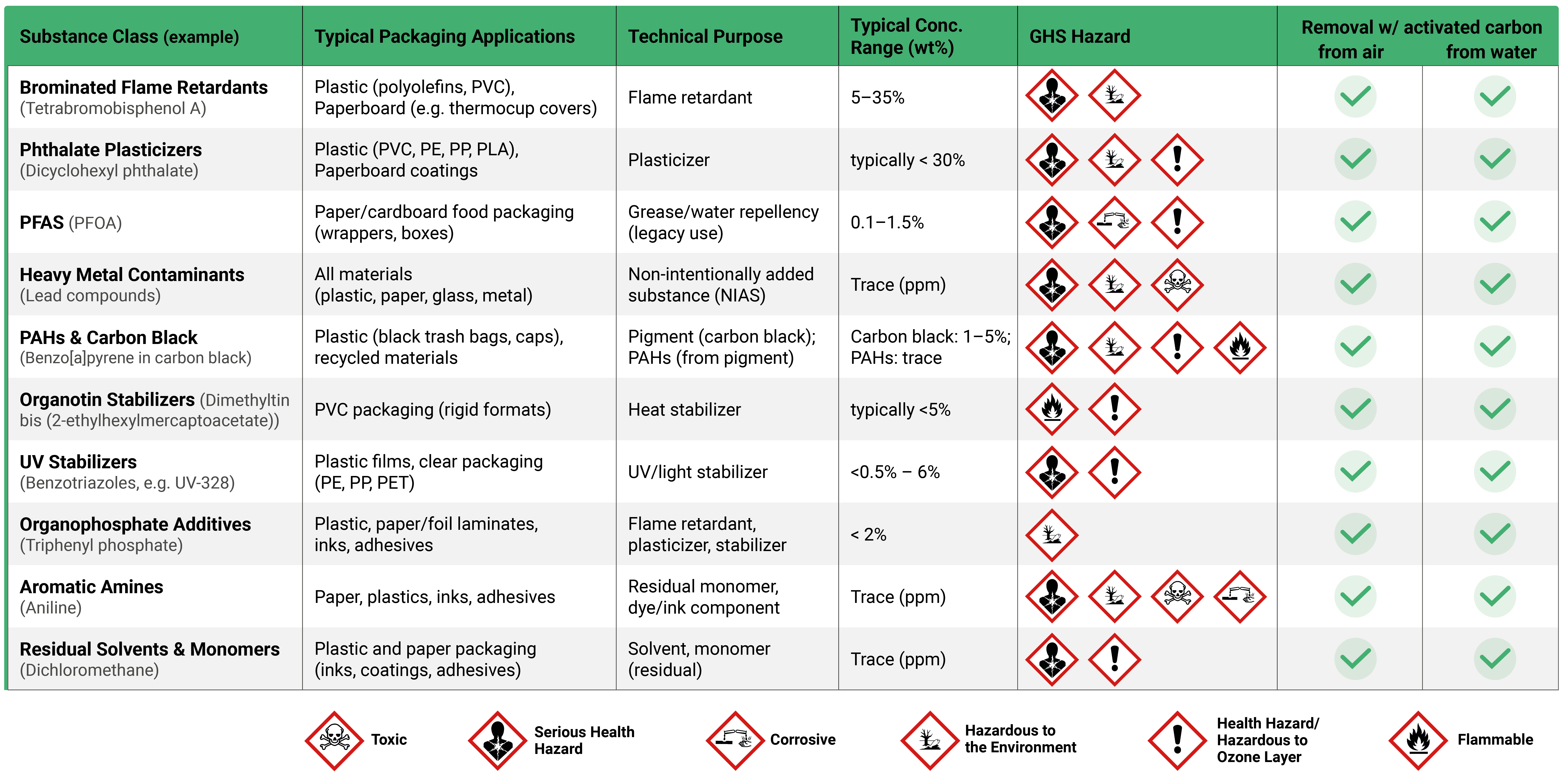
Among these, we can find:
PFAS
PFAS are a family of thousands of synthetic POPs. Many are carcinogenic, mutagenic or reprotoxic (CRM). They are known as ‘forever chemicals’ as they bioaccumulate. This is particularly true for long-chain PFAS, such as PFOA and PFOS, whose emissions are now heavily restricted.
VOC
When reacting with sunlight, VOCs make tropospheric (ground‑level) ozone (O3), which causes smog and may lead to respiratory disease and premature deaths. This is one of the reasons why the TA Luft has reduced VOC emission limits.
PAH
Polycyclic aromatic hydrocarbons (PAHs) are a group of organic compounds that are formed primarily during the incomplete combustion of coal, oil, gas, wood, or waste. They are widely studied because some PAHs can persist in the environment and may pose risks to human health and ecosystems.
BFR
Brominated flame retardants (BFRs) are added to materials such as plastics, textiles, and electronic products to reduce flammability and slow the spread of fire. Like the other SHVCs mentioned earlier, they can accumulate in the environment.
Which SVHC Regulations Should Recyclers Comply With?
In accordance with the Registration, Evaluation, Authorisation and Restriction of Chemicals (REACH) regulation, the European Chemicals Agency (ECHA) has compiled a list of SVHC. Companies must verify whether their emissions contain any of the listed compounds and in case remove them to meet limits imposed by local authorities.
In addition to this, an SVHC might end up on other lists. For instance, Tetrabromophthalate (TBPH), which is a BFR, is currently under review for becoming a Persistent Organic Pollutant (POP). A recent study found that activated carbon filtration removed up to 99% of BFR from the dissolution recycling of polystyrene.
Finally, players in the packaging industry must be aware of the revision of the Packaging and Packaging Waste Regulation, whose requirements are applicable from 12th August 2026. In particular, as reported by Article 5(1):
“Packaging placed on the market shall be so manufactured that the presence and concentration of substances of concern as constituents of the packaging material or of any of the packaging components is minimised, including with regard to their presence in emissions and any outcomes of waste management, such as secondary raw materials, ashes or other material for final disposal, and to the adverse impact on the environment due to microplastics.”
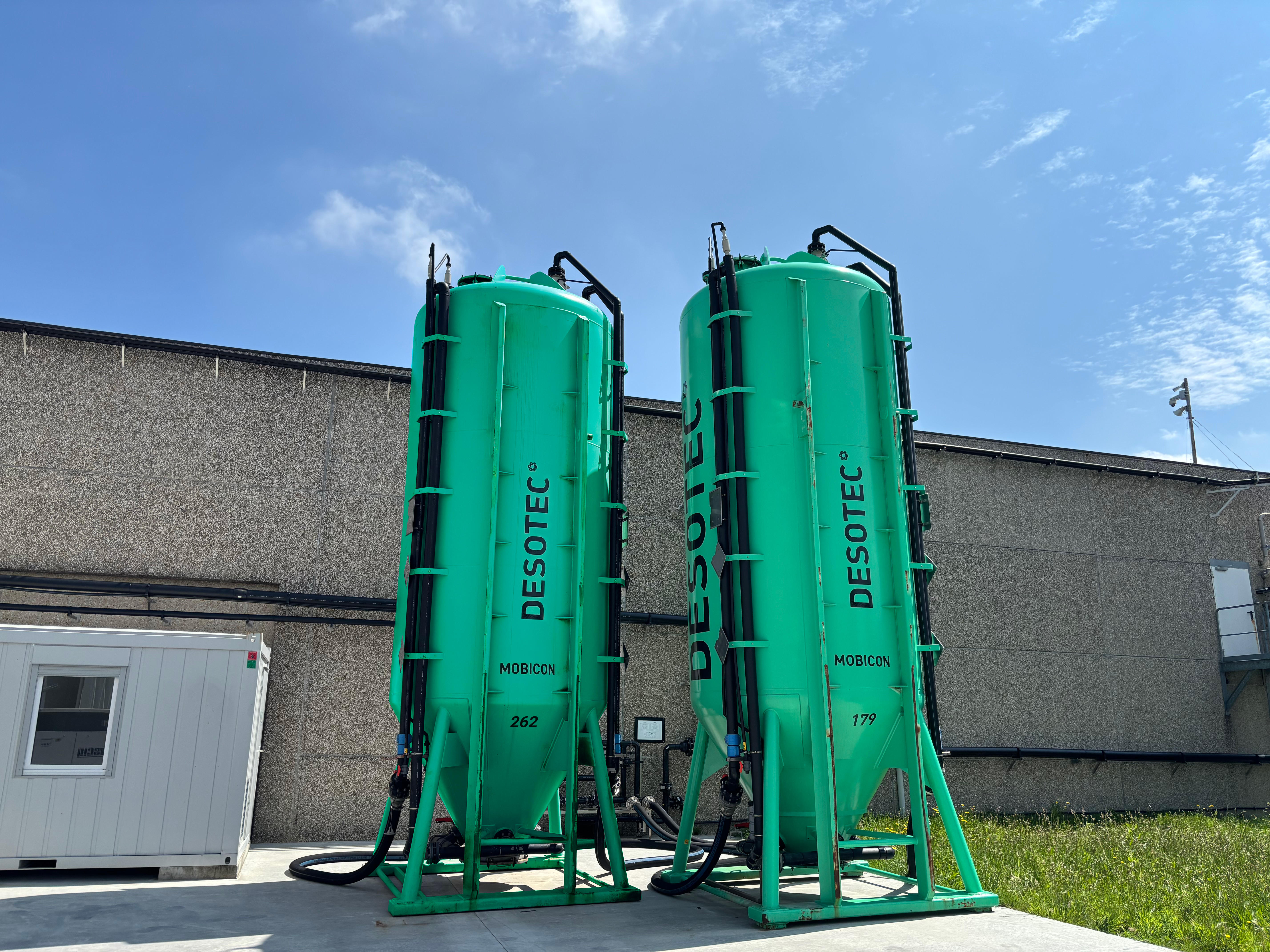

DESOTEC solution
Activated carbon filtration is a best available technology (BAT) to remove SVHC emitted by recycling plants. DESOTEC has tested the efficiency of this purification route in real scenarios.
CASE STUDY 1 : Removing VOC from air emissions produced by French packaging
A company in France produces metal packaging for beverages. They had to remove VOC (170mg/m³) from their air flow (16000 m³/h). Once the firm reached out to DESOTEC, our engineers recommended an AIRCON V-XL. After installing our mobile filter, the VOC outlet concentration was reduced to below the legal limit.
CASE STUDY 2 : Purifying wastewater of PFAS in Belgium
A firm manages a water purification system on a Belgian site. Wastewater is released in a nearby river, thus implying tight limits to respect. Accordingly, the company had to bring down PFAS concentration from 300 to 100 ng/l. To do so, they reached out to DESOTEC and we suggested installing four Mobicon filters downstream of their water purification system. Two filters are placed in parallel at the front to capture the organic components (TOC). Ahead of each TOC filter, there is another unit designed to remove PFAS. Once the purification system went live, the PFAS level complied with emission limits. Read more here.
CASE STUDY 3 : Removing PAHs from groundwater at a Spanish site
We took on a remediation project in Oviedo for eliminating PAH from groundwater. The contaminated stream (flow rate of 7 m³/h) contained an average PAH level of 80 mg/L. After installing two mobile filters (MOBICON 2000), the pollutant was completely removed.
Conclusion
Removing SVHCs from packaging waste is becoming essential to achieve a sustainable and compliant recycling process. DESOTEC’s solution lets recyclers accomplish this transition in a cost-effective way.
-
AOX removal
To preserve the health of rivers and soil, it’s essential to reduce chlorine and Adsorbable organic halides (AOX) in wastewater and groundwater to a minimum. -
Industrial PFAS removal
Finding PFAS in the environment is a huge concern globally. For industry, it’s a challenge that companies must now tackle head-on. DESOTEC provides reliable, flexible solutions to eliminate PFAS pollution permanently and sustainably. -

Our filtration solutions
We offer a wide range of filter models and carbon grades to suit your industrial water or air purification requirements.