Optimising H₂S removal and reducing TCO with DESOTEC’s carbon grade for biogas
DESOTEC’s groundbreaking carbon production facility for the biogas market, PF5, is the first in the world capable of treating, reactivating and upcycling impregnated carbon with high sulphur levels coming from the desulphurisation of typical biogas and biomethane streams. It generates a renewable product of equivalent quality to virgin carbon that is then impregnated with specific chemicals to enhance the chemisorption of hydrogen sulphide (H₂S). This case study explores how one French biogas customer has recently switched to the PF5 carbon grade and has quickly seen dramatic improvements in loading capacity and filter lifespan, saving them money and streamlining their operations.
Key takeaways
- Switching from a standard impregnated carbon grade to DESOTEC’s PF5 impregnated carbon increased the H₂S adsorption drastically, leading to significant cost cutting.
- It also captures more volatile organic compounds (VOCs), extending the lifespan of any downstream VOC filters.
- DESOTEC’s full-service solution reduces the total cost of ownership (TCO) and saves customer’s hassle: we provide ongoing support to optimise filtration set-ups; and we take care of all filtration waste, including paperwork, logistics, and the treatment and recycling of carbon – even with a high sulphur load.
- As the new product from our PF5 facility is more efficient, Europe-made from renewable sources, and recyclable, it has a much lower carbon footprint than virgin carbon from non-renewable sources often coming from Asia.
The challenge
This multinational waste management company produces biogas for co-generation at its landfill site in France. To protect the combined heat and power (CHP) engines downstream, the biogas must be purified of H₂S and VOCs, especially siloxanes.
DESOTEC has been providing this client with effective filtration services for several years. Originally, we used one filter filled with a regular impregnated carbon grade to adsorb H₂S, followed by a second filter filled with non-impregnated carbon to capture VOCs.
Once saturated, these filters would be exchanged for new ones, and we would transport the old filters away from the customer’s site for safe carbon waste handling. The carbon laden with VOCs was reactivated in our furnaces for reuse, but the technology did not exist to reactivate the H₂S-laden carbon, so it was sent for safe third-party disposal - until DESOTEC developped its PF5 facility.
With the development of our innovative carbon production facility for the biogas sector, PF5, we were eager to offer this client an even more efficient, sustainable, and cost-effective solution. We recommended the company switch to our new PF5 carbon grade - produced locally in Europe, and achieving same quality as virgin carbon.


The solution
To illustrate the benefits of our PF5 carbon grade to this customer, we pointed to the experience of other biogas clients who had already made the switch:
- Some have found the new carbon grade to be so efficient for H₂S removal that they have been able to remove pre-treatments from their filtration system.
- One has seen the lifespan of its downstream VOC filter, filled with regular carbon, extended by at least 20% – a figure that DESOTEC now plans to enhance through further system optimisation at this client’s site.
Thanks to our long-established partnership, this French customer was prepared to trust us and trial the new PF5 carbon grade, on the understanding that it would be easy to switch back if necessary.
In late 2023, we therefore replaced the client’s two filters with just one AIRCON HC-XL model, filled with our new PF5 impregnated carbon grade to capture both H₂S and VOCs.
For applications emitting high VOC concentrations, we would generally install a second filter filled with standard carbon, but this is rarely necessary for landfill biogas. A streamlined set-up is more cost-effective and operationally simpler for clients, as it requires fewer filter exchanges and generates just one waste stream.
The results
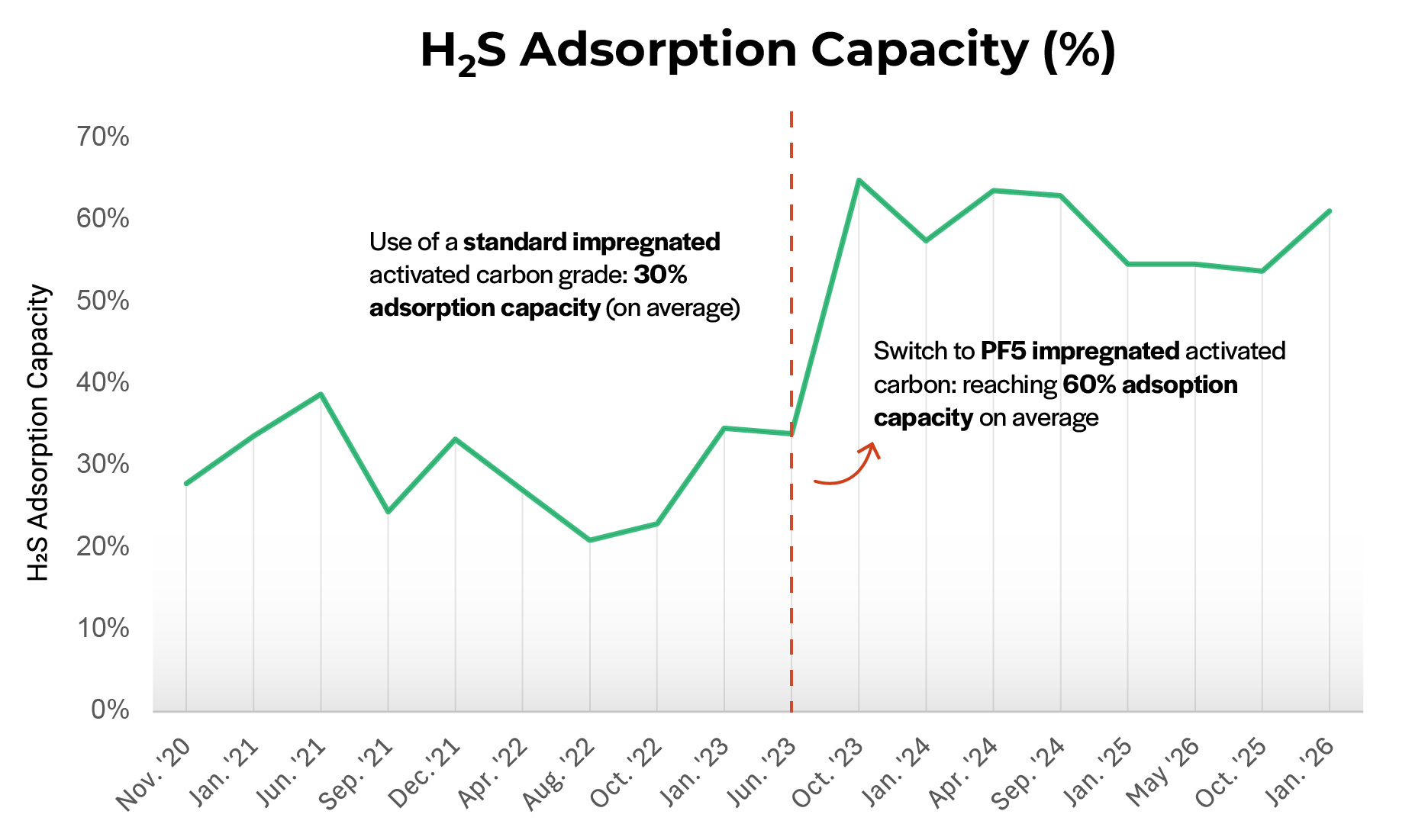
The solution has quickly proved to be even more effective than DESOTEC had forecast. Following the switch of carbon grades, from a standard impregnated carbon grade to our PF5 impregnated carbon, the H₂S loading capacity rose from round 30% on average to 60% and above – as shown on the graph below.
Filter lifespan has been extended dramatically: previously, the customer had required five filter exchanges per year, but this has now been reduced to three, cutting costs considerably.
Outlet measurements show that H₂S concentrations are reduced from 5500 ppm to zero or just a few ppm, while siloxanes are consistently below detectable levels.
Like many biogas producers, this client also had a small fixed filter in place as a backup, which is now rarely needed – further reducing running costs.
On our advice, the client will shortly optimise the system by installing a second AIRCON HC-XL filter in series, filled with the same PF5 product. By doubling the carbon filter beds, this set-up will achieve even higher loading capacities for both H₂S and VOCs, further extending the filter lifespan and reducing costs and hassle.
The client is delighted with the outcome, and the site manager is now considering replicating this filtration set-up at nine further biogas facilities under his management.
To further close the loop, not only is the carbon reactivated and recycled in our PF5 plant, but the recovered sulphur is also used to create gypsum. This is then sold to the construction sector as a building material, lowering DESOTEC’s carbon footprint and making this entire recycling process fully circular.
-

Our unique service
Our closed-loop, full-service model is as unique as your business needs. We’ll define the right filtration setup and safely recycle filtration waste, making it easy to go green. -
Biogas and renewable energy
Full-service, sustainable biogas and biomethane treatment to protect equipment, control odours, and make best use of natural resources. -
Hydrogen Sulfide (H₂S) Removal
Remove H₂S from air emissions and biogas using DESOTEC’s mobile activated carbon filtration system; reduce odours, protect equipment and prevent acid rain.